

Summary: Soliguide, an initiative by the Solinum association, is a digital guide that lists essential services for people in precarious situations. After three years of operation, we have learned a great deal. As we continue our expansion strategy across France, we are exploring future development prospects and the feasibility of allowing our existing map to run autonomously. Our hypothesis: to maintain the high quality of information necessary for properly guiding our users, it is impossible to leave a map to run entirely on its own. However, we have just launched Soliguide professional accounts, which allow organizations to update their information directly. Here is how it works!
Soliguide is a truly innovative project: beyond its "tech for good" aspect, it is also the first up-to-date map covering both social emergency services and socio-professional integration, deployed across multiple French regions.
The need for information and centralization is obvious to both beneficiaries and stakeholders in the social sector. This is why various guides, data tables, and participatory maps exist in certain regions or for specific audiences, managed by associations, collectives, or individuals. When these are not supported by public authorities, they rarely survive or offer only a handful of locations with information that is years out of date. Not very reassuring, is it?
After watching dozens of guides and participatory maps launch and fail, we can say with certainty:
No, a map will never populate itself, and more importantly, it will never maintain itself on its own. The listed organizations will not adopt guides or maps without adapted digital tools, clear methodologies, and significant change management.
We have identified several hypotheses that explain why Soliguide defies this trend and enjoys strong growth prospects:
It is designed by and for its stakeholders, whether they are institutions, non-profits, or direct users. This co-construction dynamic allows us to continuously improve the tool and ensure it remains useful on the ground.
By sharing a single tool across multiple regions, the costs associated with digital investment are spread out. The broader the tool's scope, the lower the investment required for each individual region. Furthermore, this approach enhances its long-term sustainability.
Data quality is at the heart of our concerns. Misdirecting an already vulnerable person can have disastrous consequences. That is why it is essential to do everything possible to provide accurate, up-to-date information at all times.
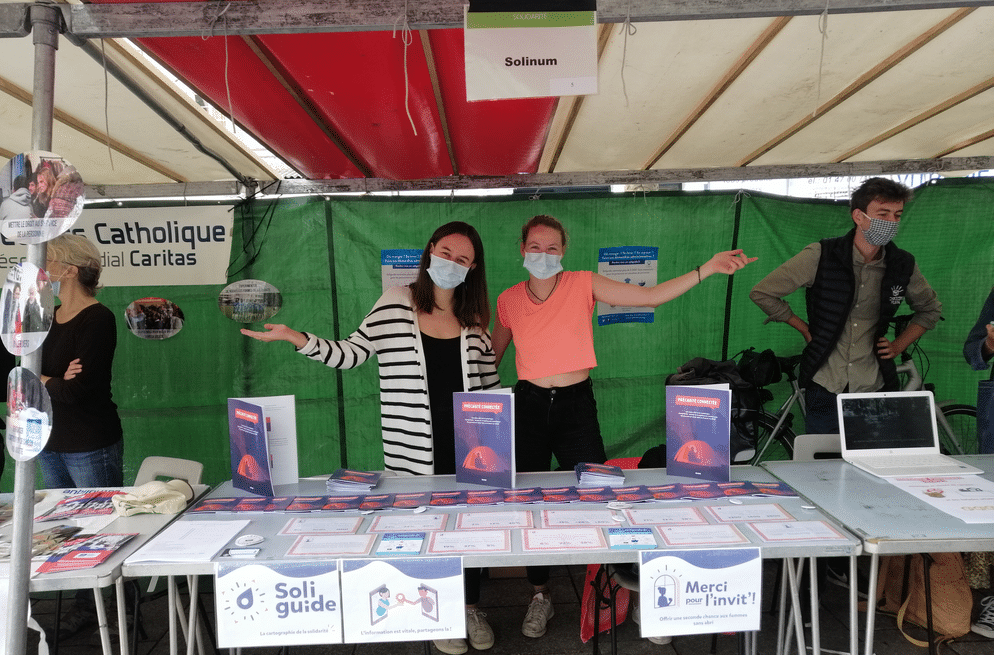
To achieve this, we have bet on local presence, with permanent teams in all regions covered by Soliguide. They build relationships with the many stakeholders in the social sector, ensure the quality of the information provided, and relay feedback on areas for improvement.
However, one question remains : how can we successfully expand our reach while maintaining exemplary data quality, without an exponential increase in our human resources?
Thanks to committees bringing together institutional actors, non-profits, and the people we serve—such as the one led in Paris with theANSA (Agence Nouvelle des Solidarités Actives)—enabling organizations to update their own information became one of our top priorities in 2020. And it worked out well: instead of the usual two update periods for the summer and Christmas holidays, four complete updates were carried out this year!
Starting March 16, the entire Soliguide team mobilized to update 80% of the database in just one week, in order to effectively guide vulnerable populations at a time when all social services were being disrupted. This was also when we first launched the ability for organizations to update their own information in real time on Soliguide. Through this channel, 107 autonomous updates were completed, representing approximately 3% of the Soliguide listings online at that time.
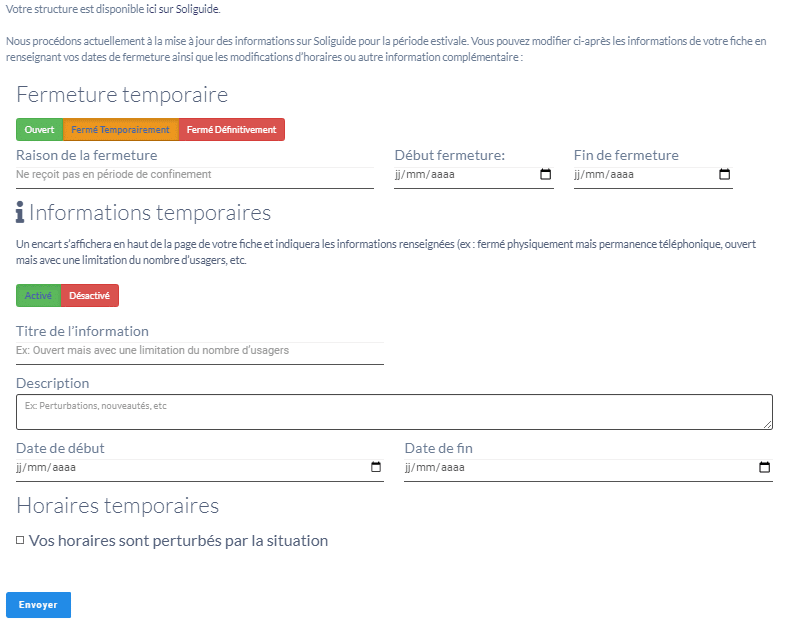
Starting June 28, we launched our usual summer update, aimed at identifying changes related to the holiday season (closures, hours, etc.). This time, by combining the extra time afforded by a quieter period with improvements made to the form following the first experiment, 401 organizations successfully updated their own information (9%). However, after verification by local teams, 40% of these updates required clarification: some fields were misunderstood, or information was missing.
Starting October 30, the team mobilized once again to quickly update the database and guide the public through another complex situation. We launched another update cycle accompanied by self-service modification forms. This time, in addition to further improving the form, we decided to verify the information before publishing it, given the figures from the summer. In total, 18% of the updates made during the second lockdown were completed by the organizations themselves—double the previous rate!
Another specific aspect of this update: following funding issues in Nantes, the branch's activity was gradually slowed down starting in September 2020. To turn this situation into an opportunity, we decided to analyze the behavior of a territory left without a local salaried branch.
Thanks to the work carried out over nearly two years, we had a good testing ground: the database was high-quality and comprehensive, and our contact list was up to date. After informing local solidarity stakeholders about the situation, the update was launched in the same way as in all other territories, but keeping only the automated and volunteer-led parts of the process. Although the permanent Solinum team contributed, notably by coordinating volunteer actions, we reached the result that 31% of the database was updated by the organizations themselves or by volunteers. While this is not enough to maintain a high-quality, comprehensive database, it is a start.
Building on these findings, we are excited to announce the launch of a brand-new feature on the Soliguide website: professional accounts! More than just simple forms, solidarity organizations now have access to an account that allows them to update all their location information in a flash, as well as invite team members. More features are coming soon to continue providing tools for those working in the solidarity sector.