

Impact evaluation is the hot topic of the moment and has even made its way to the National Assembly for the Impact Measurement Summit*. For non-profit organizations, it is an essential step in demonstrating transparency and effectiveness. However, quantifying social impact is not easy, especially for projects with indirect impact. Increasingly used in France, the Social Return on Investment (SROI) methodology is an innovative approach that can prove useful, as evidenced by the organization Solinum.
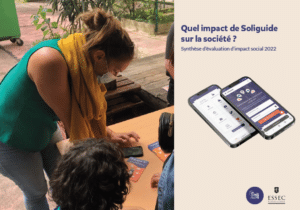
It is not uncommon for social impact projects to be perceived as mere costs. This situation primarily highlights the difficulty many organizations face in evaluating and showcasing their impact. When the organization Solinum began evaluating its Soliguide project (the first mapping of solidarity services), the challenge was significant. Soliguide is a digital tool that provides an indirect service: it helps people access the information they need to then access a service. It is therefore difficult to rely on "simple" metrics, such as a food bank measuring the volume of goods distributed.
How, then, can its effectiveness be proven? The organization opted for an innovative approach: Social Return on Investment (SROI), which measures the social and environmental outcomes of a project by taking into account invested resources alongside financial and social results. This allows for the valuation of social impact relative to cost. As explained by Elise LECLERC, Director of the Laboratory for Social and Environmental Impact Evaluation and Measurement (E&MISE) at ESSEC, "The SROI approach is a participatory, activist method of monetization that involves stakeholders in the assumptions behind monetary valuation. It seeks to value all social impacts, even those without a market price, such as increased dignity or restored self-confidence. It is based on the idea that even if an impact has no price, it still has value."
Another advantage is that SROI reconciles the complexity of impact with a simple result that is understandable to everyone. The SROI calculation for Soliguide revealed that for every 1 euro invested in the project, at least 1.93 euros of social value is created. Behind this figure lies a multitude
of impacts, yet the positive effect of the project on society relative to the contributions is immediately clear.
SROI can be a wise approach for taking impact assessment further, as shown by the example of Solinum. However, implementing such an evaluation requires resources to collect and analyze data, as well as methodological rigor in valuing impacts. It can be costly and is not suitable for every project.
Mandating SROI across the board could exacerbate inequalities between organizations and encourage the inflation of measured impacts. In impact evaluation, there is no magic formula. The richness of this field lies in the diversity of evaluation methodologies, which allows for adaptation to the resources, objectives, and characteristics of each project.
To learn more: solinum.org
Sources:
*https://impact-tank.org/sommet/